News

Why We Redesigned the Foot Pegs for Sur-Ron and CRF Riders

2026-08-07 0 Leave me a message

We've all had that split-second where your boot loses the peg on a rough section. The bike lurches, your weight goes somewhere it shouldn't, and suddenly you're not riding anymore — you're just along for the fall. Sometimes you catch it with a dab. Sometimes you're picking dirt out of your helmet.

Stock foot pegs are one of those areas where manufacturers cut corners to hit a price point. Narrow, flat, smooth. They work fine on pavement. But the moment you hit loose gravel, mud, or a rocky climb, there's virtually no real grip between your boot and the peg. That's not a skill issue — it's a hardware issue.

What This Peg Actually Does

We focused on two fundamental changes: more contact area and a completely different surface structure.

Most stock pegs are just flat aluminum plates with shallow ridges stamped into them. They provide some friction when everything is dry and clean. Add a little mud or water to your boot soles, and that friction drops to nearly zero.

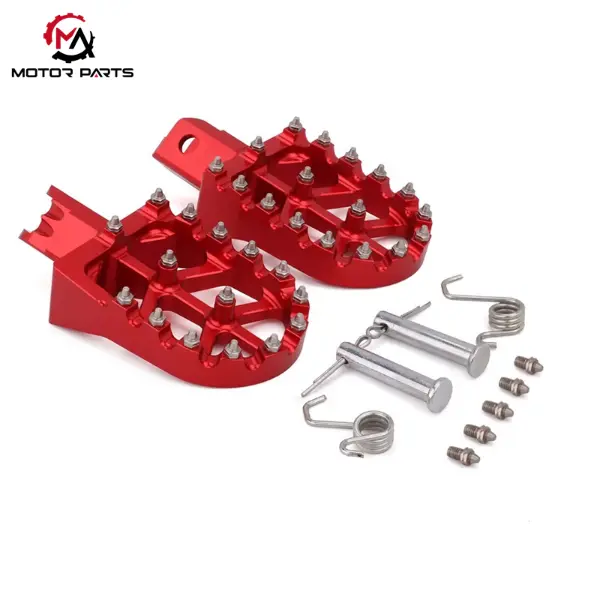
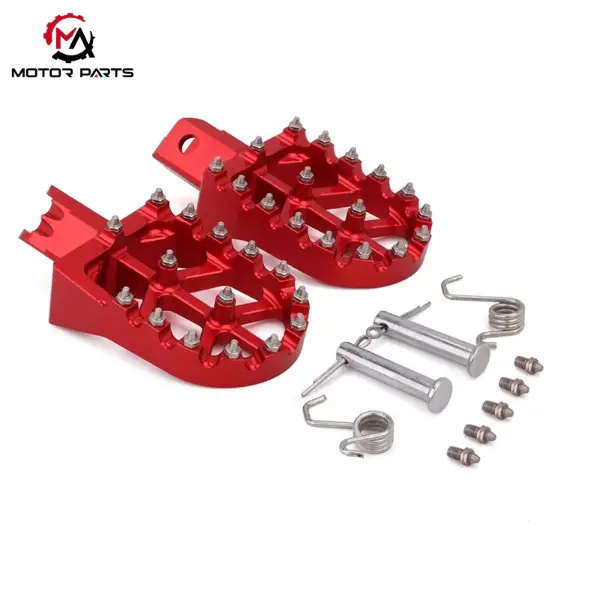
We replaced that flat surface with three-dimensional raised treads. Instead of your foot resting on top of the peg, the teeth bite directly into the tread pattern of your boots. It creates a mechanical lock. The peg stops being a place to rest your foot and becomes a structure that holds it.

Width is another factor we addressed. Standing up on a narrow peg means your foot is only partially supported, which concentrates pressure on a small area. That leads to fatigue on longer rides. The wider platform distributes your weight more evenly. And on side slopes or aggressive turns, the extra width gives your foot something to push against — you're not constantly fighting to keep your foot from sliding off the edge.


Replaceable Teeth: A Detail That Matters

On most stock pegs, the grip teeth are machined as part of the main body. Once they wear down, the entire peg is done. That's expensive, and it's wasteful.

We built this peg with replaceable hardened steel teeth. The steel is quenched and tempered, so it's significantly harder and more wear-resistant than aluminum could ever be. Rocks, mud, sand — it takes a lot of abuse before these teeth show significant wear.

And when they do eventually round off? A few screws, swap in new teeth, and the peg body keeps going. No need to replace the whole unit.

There's another benefit to this modular design that we didn't initially plan for: you can adjust the tooth count to match your riding style. Commuting around town? Install fewer teeth so they're not aggressively biting into your soles. Heading into the mountains? Pop in the full set for maximum grip. One set of pegs covers multiple use cases.


CNC Machined, Direct Fit

These aren't welded pieces assembled from multiple parts. The body is CNC machined from a single block of aluminum. Every mounting hole, radius, and dimension follows the original factory data. When you bolt them on, they align perfectly. No drilling, no shims, no persuasion with a hammer.

The aluminum body gets a hard anodized finish. This serves two practical purposes: it increases surface hardness so sand and rocks don't gouge deep scratches, and it bonds the color into the material itself. Unlike paint, it won't flake or fade after a few months of use.

We cut weight with hollow sections where the structure allows it. Each peg weighs 400 grams. But we didn't chase lightness at the expense of strength — the load-bearing areas keep enough material thickness to handle heavy landings without bending.


Specifications and Fitment

Dimensions:

  • Overall length: 125mm

  • Peg platform width: 56mm

  • Mounting base thickness: 38mm

  • Peg body height: 37mm

Weight: 400g per peg

Compatible models:

  • Sur-Ron Light Bee S / X

  • Honda CRF150F / CRF230F

  • Also fits CRF250F, XR150L, XR125L, Kawasaki KDX200, and other models with the same mounting interface

Colors available: Red, orange, blue, black, gold — purely a cosmetic choice, no performance impact.

Who Actually Needs These

Here's a straightforward way to decide:

If you ride your Sur-Ron or CRF primarily on pavement, with the occasional dirt road thrown in, stick with the stock pegs. They're adequate for that use case. No need to spend money on something you won't fully use.

But if you find yourself standing up for more than a third of your ride time, if you regularly hit unpaved trails, or if you notice your feet constantly shifting position trying to find grip — this is a functional upgrade, not a decorative one. The difference is noticeable from the very first ride.


A Quick Installation Note

The pegs don't come with springs. Keep your original springs and pins from the stock pegs — you'll reuse them.

All you need is a hex wrench. If you've done this before, plan on about ten minutes. If it's your first time, maybe fifteen.

When installing the steel teeth, snug them down firmly but don't over-torque. The threaded holes are in the aluminum body, and aluminum is softer than steel. Overtightening can strip the threads. A firm turn with the wrench is enough — the teeth will only tighten themselves further during riding.

Related News
Leave me a message
X
We use cookies to offer you a better browsing experience, analyze site traffic and personalize content. By using this site, you agree to our use of cookies.Privacy Policy
RejectAccept