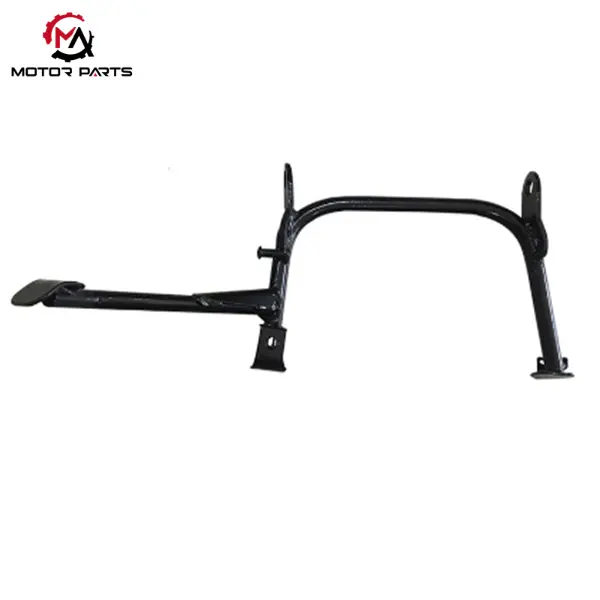
Max Trading is a motorcycle parts supplier from China, specializing in providing motorcycle engine parts for various brands and models. Max Trading collaborates with outstanding suppliers to establish long-term partnerships. We supervise the entire process from raw material procurement to production, testing, and transportation, and have detailed standards and specifications at every stage to guarantee the quality of the motorcycle engine parts is qualified.
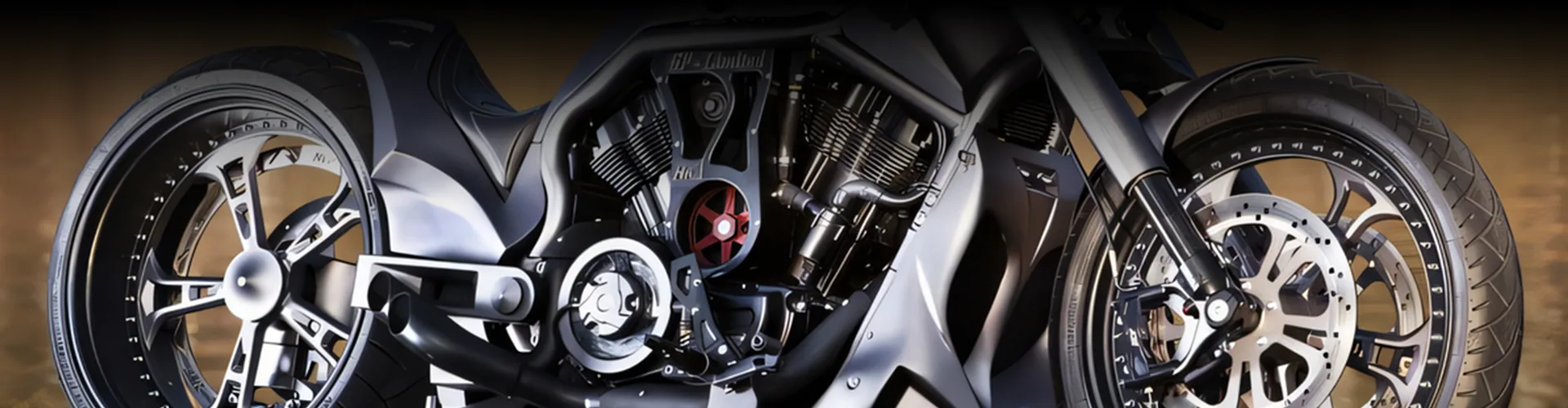
Motorcycle engine parts is the main system for motorcycle operation. It converts chemical energy into mechanical energy through the combustion of fuel in the engine cylinder. The engine burns gasoline/diesel to produce high-temperature and high-pressure gas, which drives the piston to move, and through the crankshaft, converts it into rotational power to drive the rear wheels to rotate, injecting energy into the motorcycle's travel.
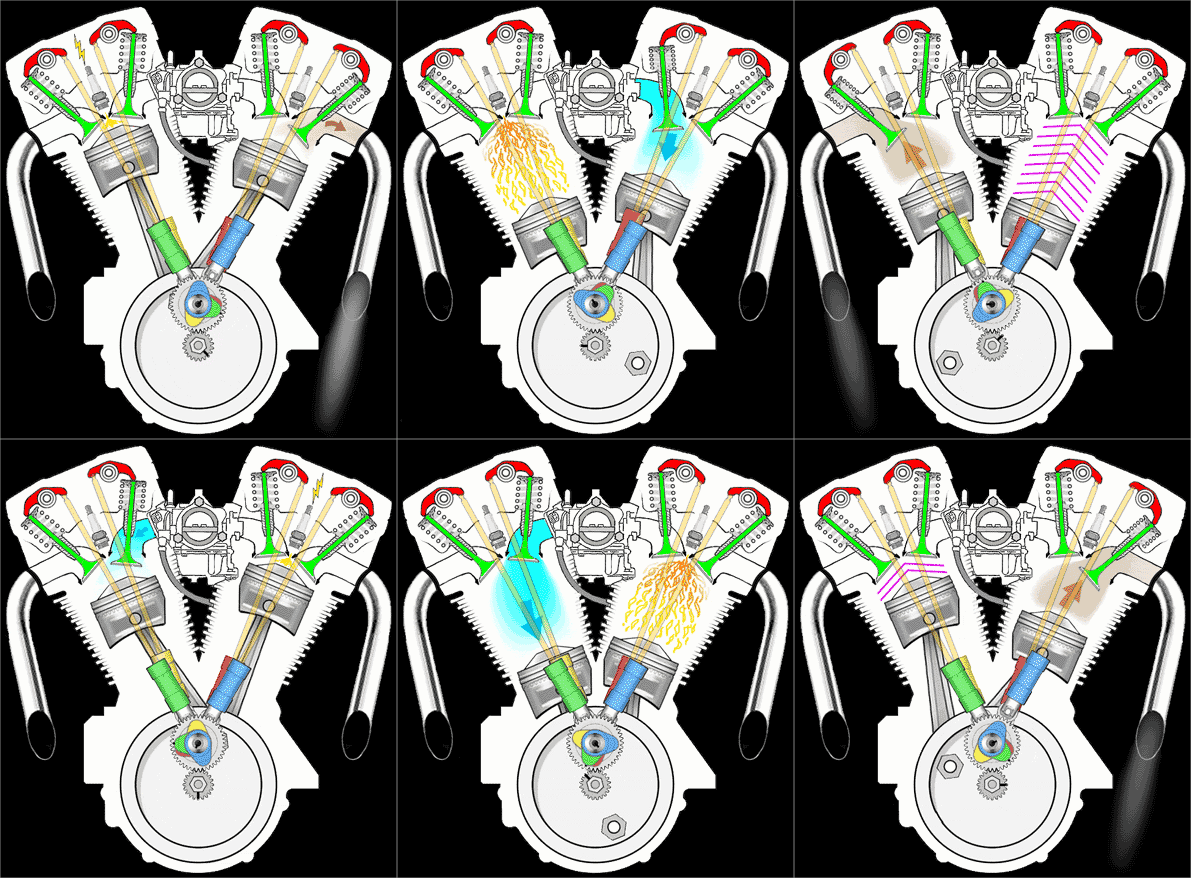
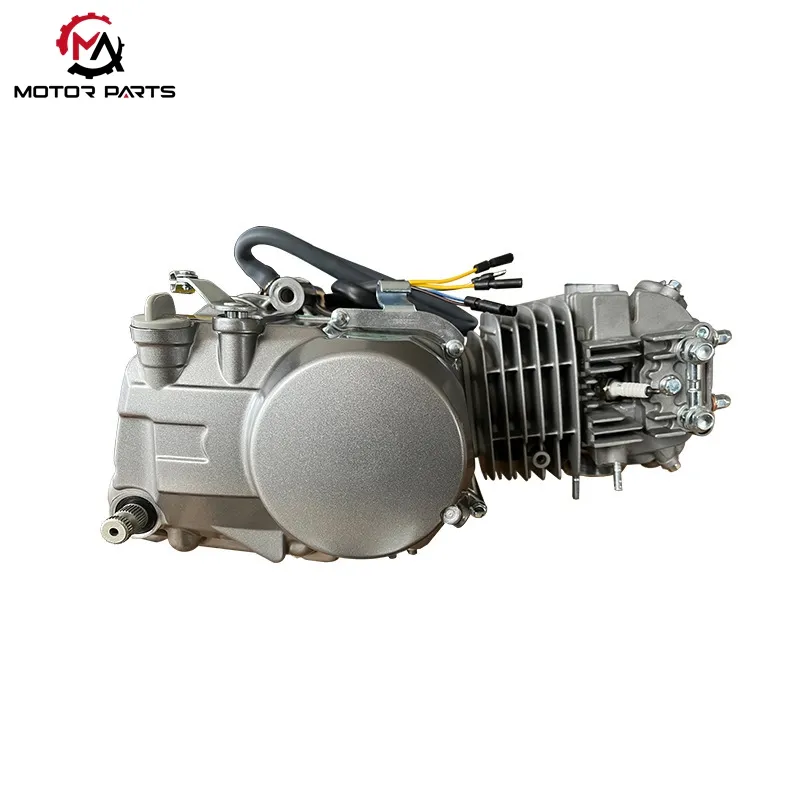
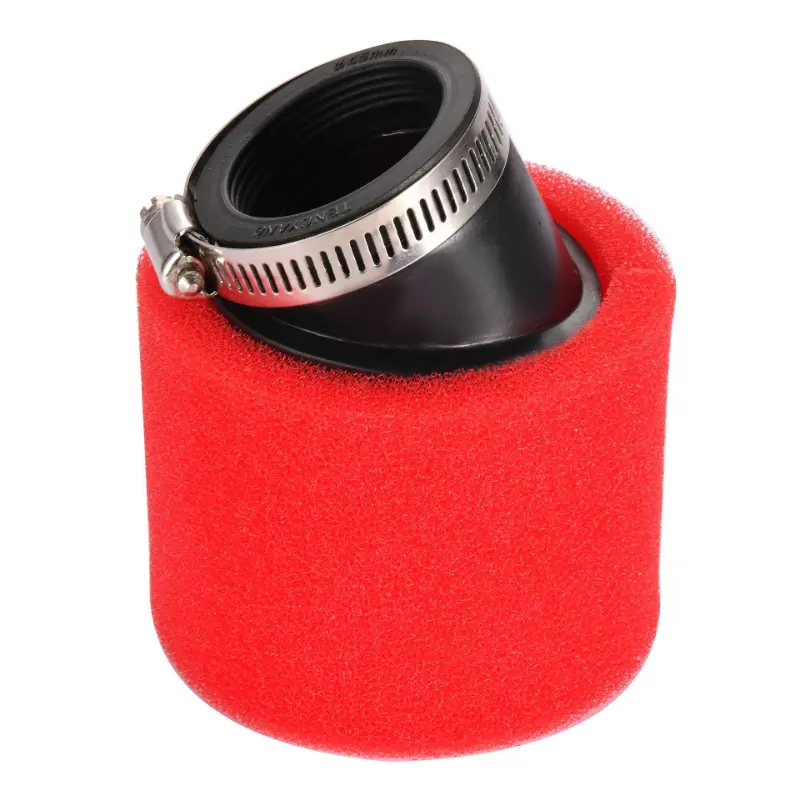
The overall structure of the engine parts consists of the following facts: basic fixing components, piston assembly, crankshaft connecting rod assembly, valve system, as well as the intake and exhaust system, cooling system, lubrication system, starting device, and other systems that assist in the operation of the engine. These important parts work together like human arms, forming the complete architecture of the engine.
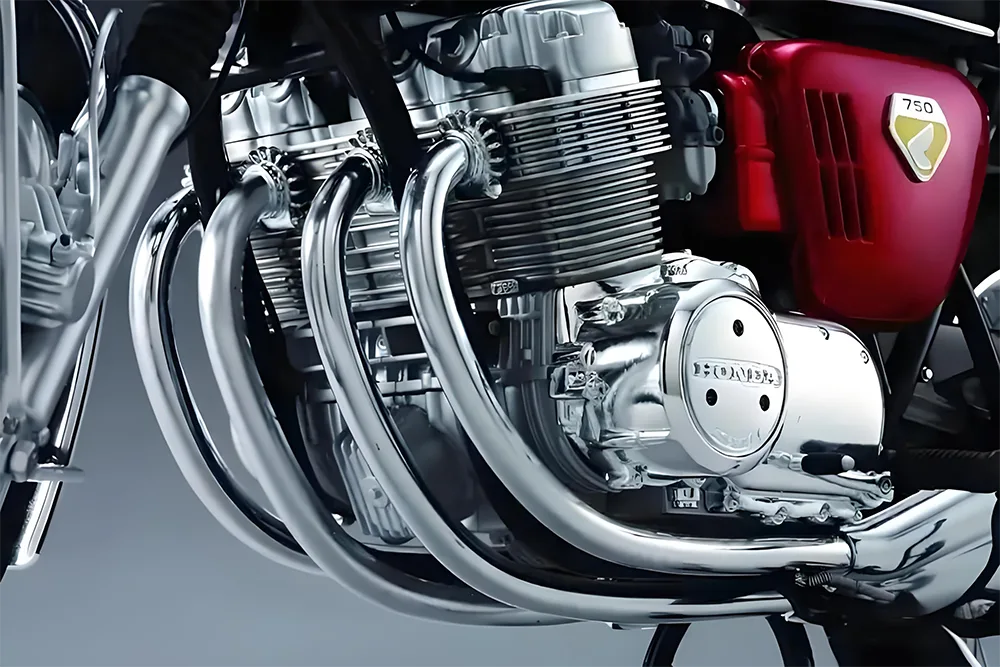
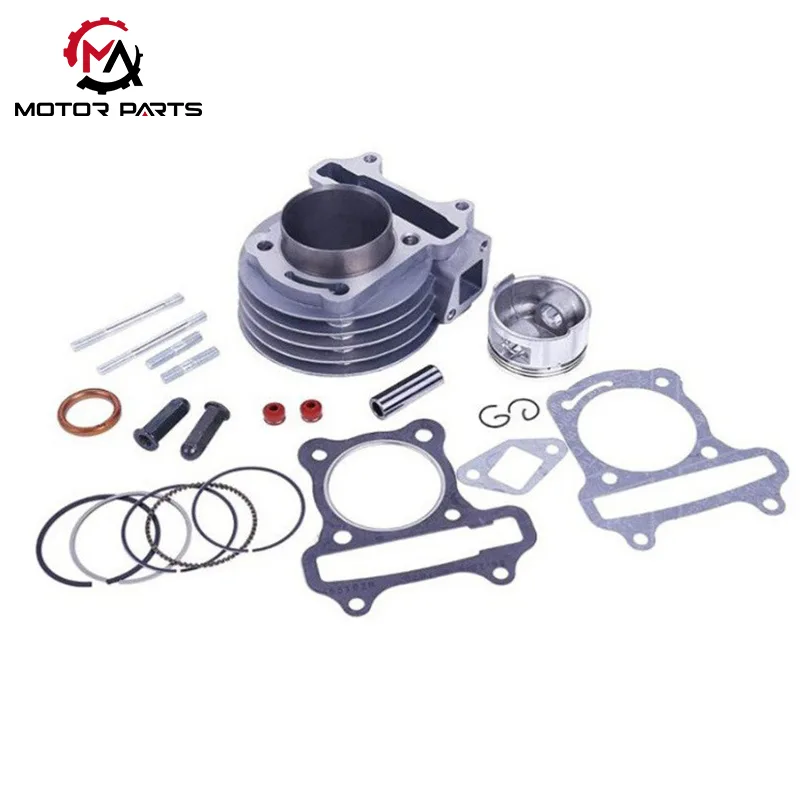
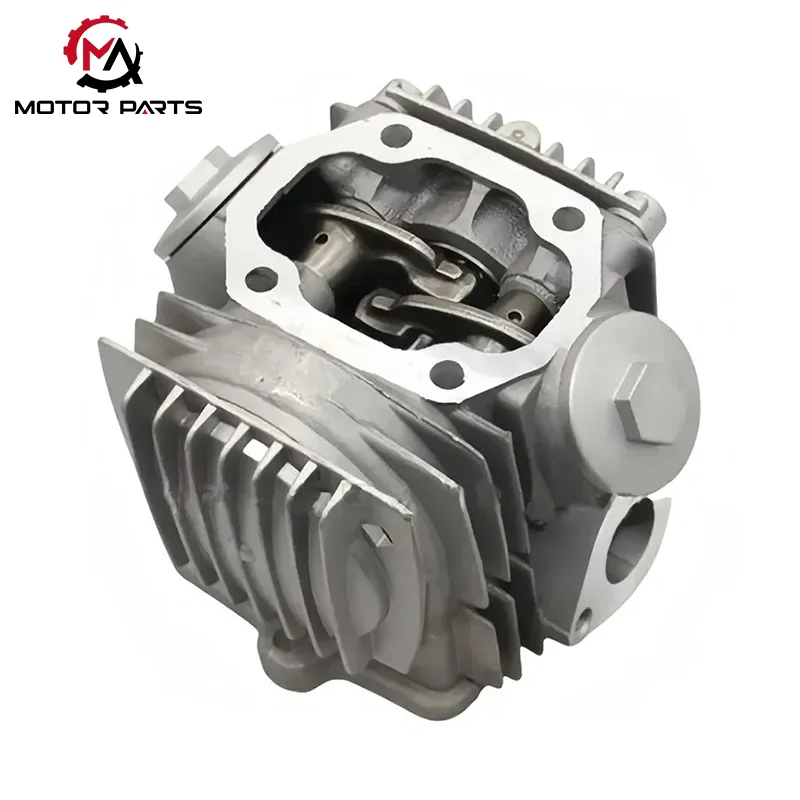
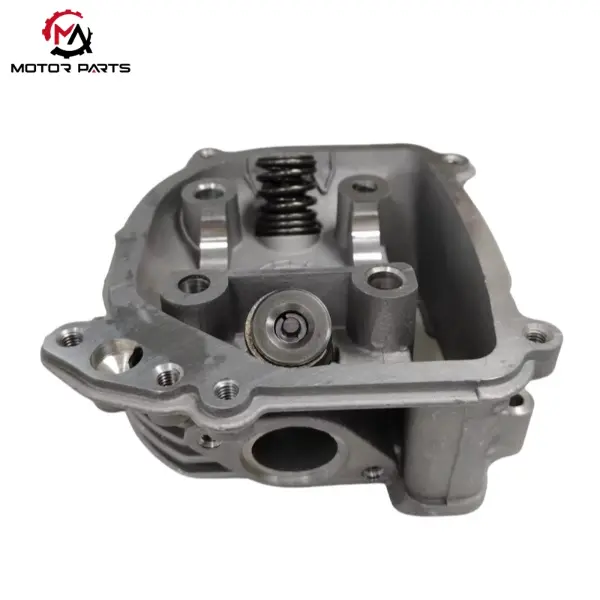
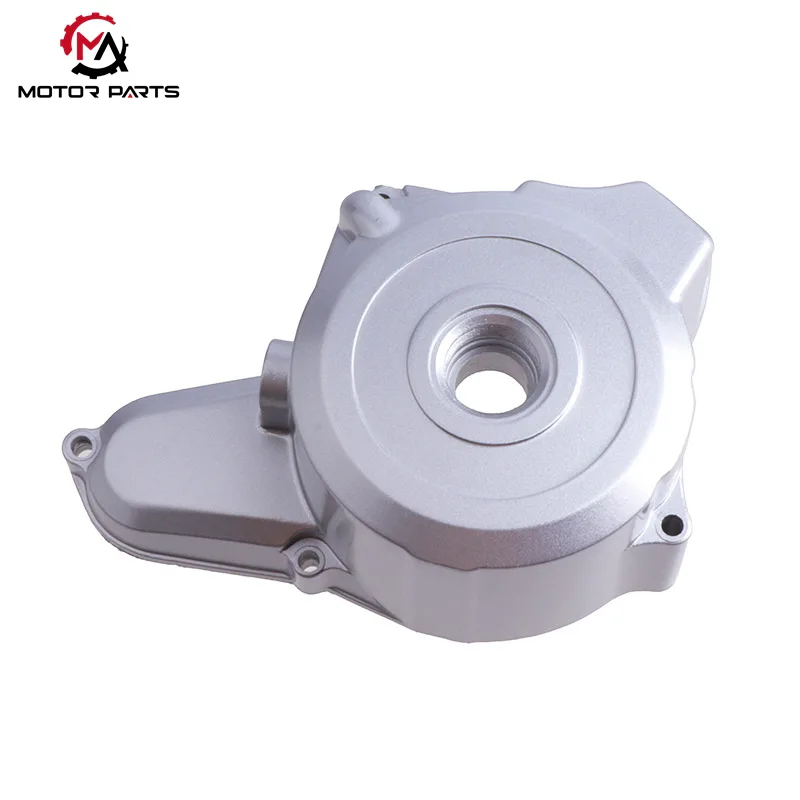
The basic fixing components, including the engine casing, cylinder assembly, and crankcase, play a very important role in the engine. Their main function is to support and cooperate with other key components of the engine, while withstanding various impacts and torques generated during engine operation. These basic fasteners form the framework of the engine and have a decisive impact on the overall hardness of the engine.
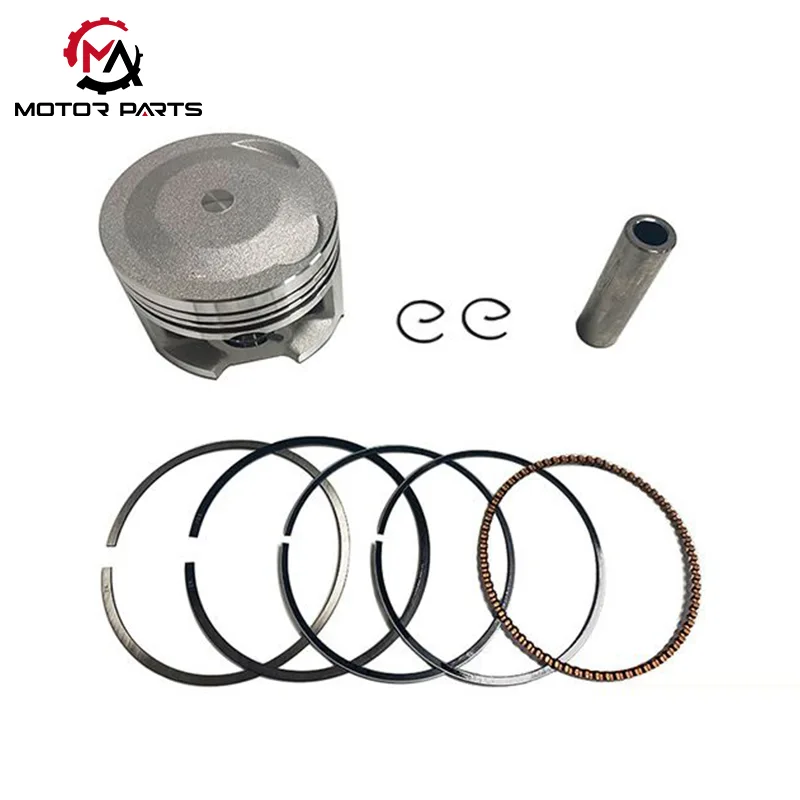
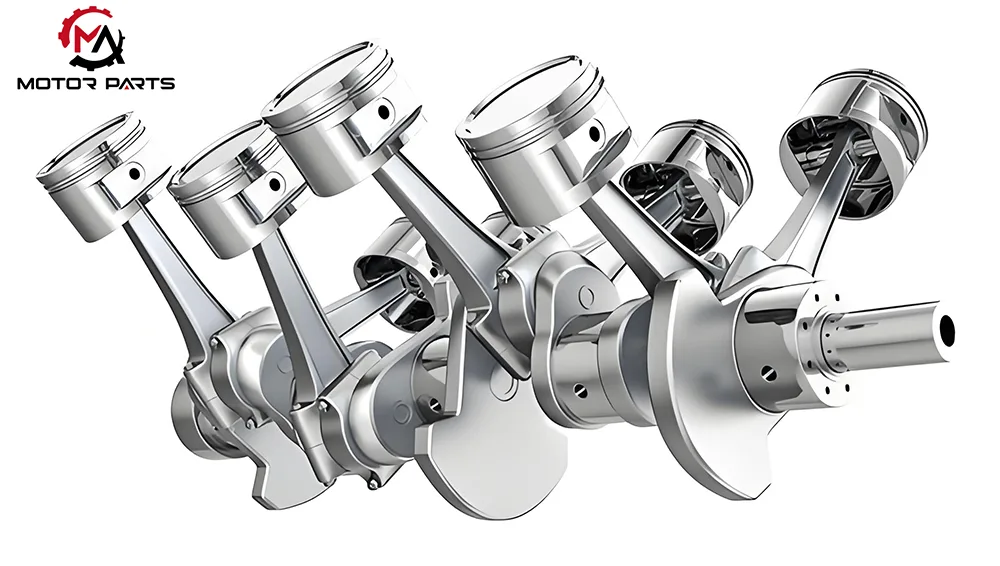
Piston group is an important component of engine operation, which together with the cylinder head and cylinder block forms an incomplete closed combustion environment, responsible for transmitting the engine's power to the crankshaft connecting rod group. The crankshaft connecting rod group is responsible for converting the linear reciprocating motion of the piston into the rotational motion of the crankshaft, and the output power drives the work of other accessories. It is mainly composed of key moving parts such as connecting rods and crankshafts, and is the core component of engine power transmission.
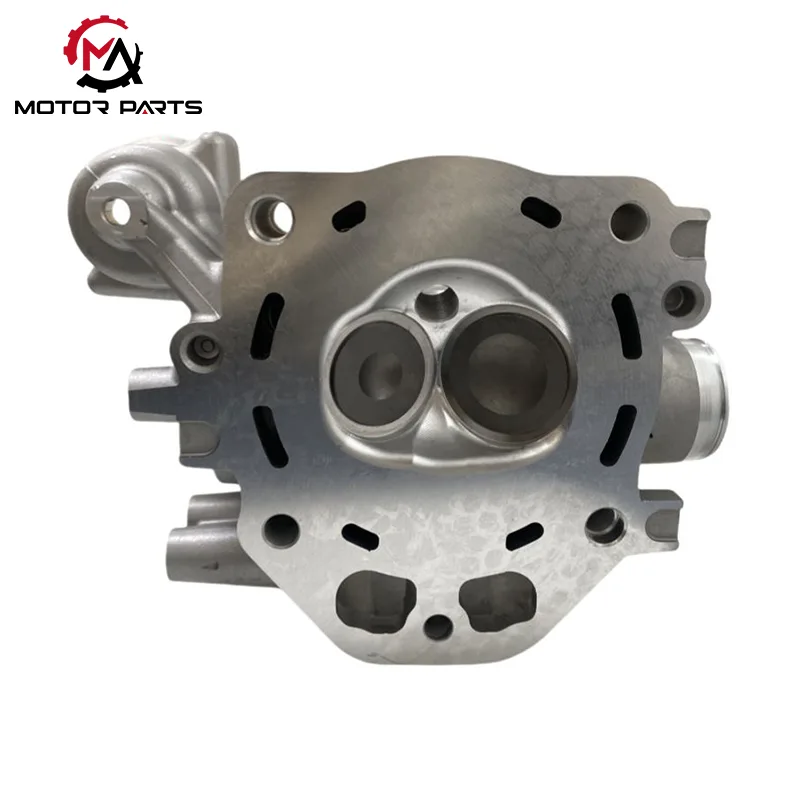
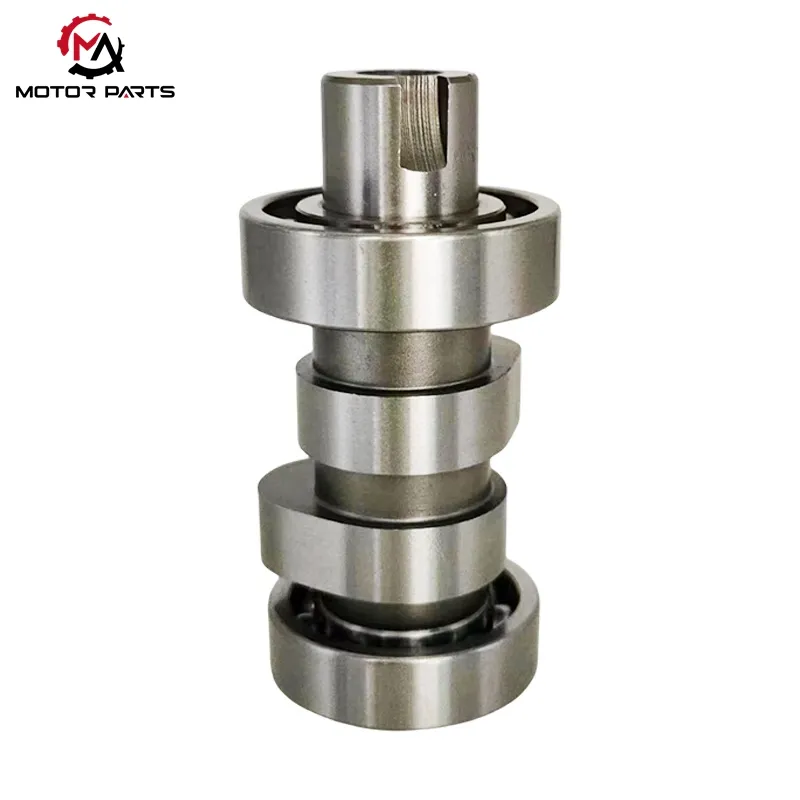
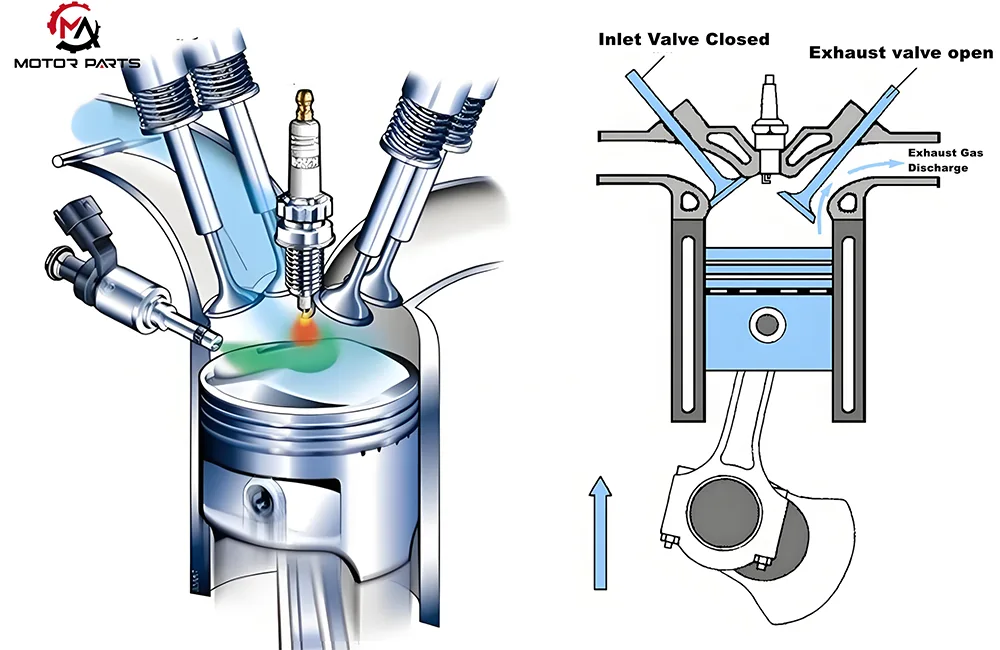
The valve mechanism is another key component in the engine, which mainly plays a role in accurately controlling the entry of combustible mixture and the discharge of exhaust gas, ensuring its stable operation while meeting the working requirements of the engine. For two-stroke engines, a port type valve train is usually used; Four stroke engines, on the other hand, are more commonly equipped with valve type valve mechanisms.
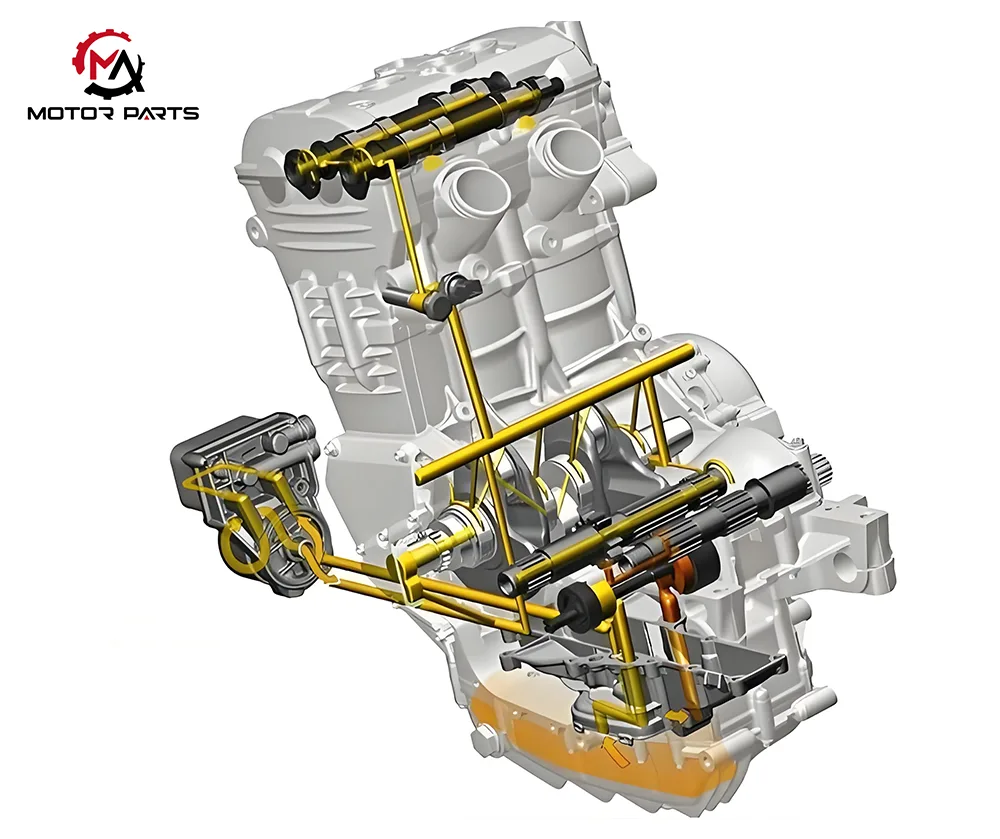
The lubrication system plays the role of a "peace ambassador" in the engine, responsible for lubricating the contact surfaces of the moving parts inside the engine, effectively reducing friction and wear of motorcycle parts, and taking away the heat generated by friction, effectively extending the working time of the engine, ensuring that all components can work stably, and extending the service life of the engine in a smooth working state. The lubrication method operates differently in different types of engines. For example, two-stroke engines typically use hybrid or split lubrication; The four stroke engine adopts a combination of splash and pressure lubrication. The lubrication system of an engine usually consists of an oil pan, an oil pump, an oil filter, and a network of oil passages and pipes.
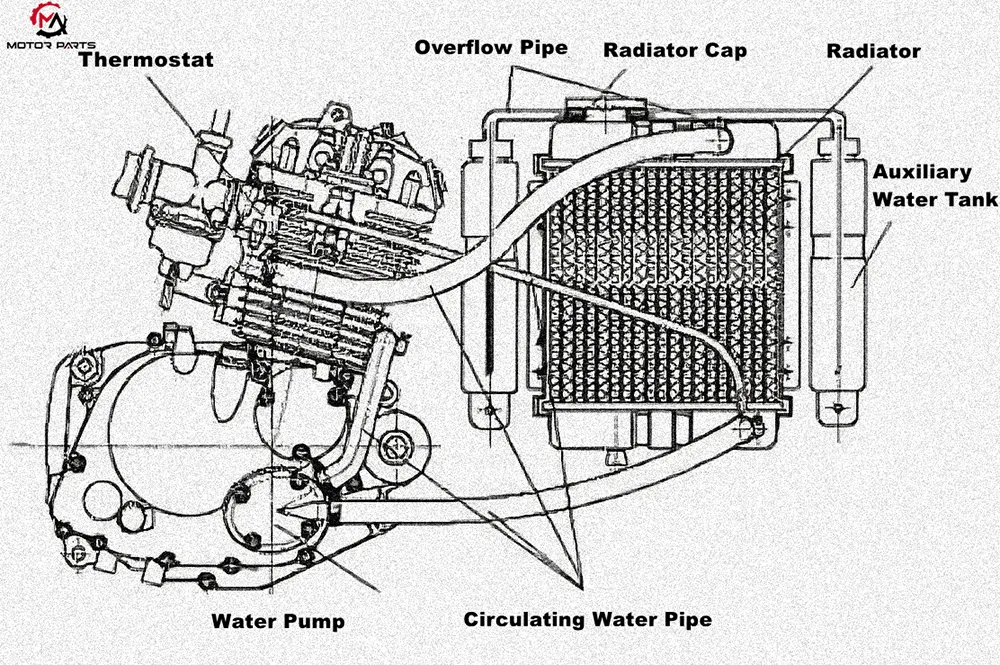
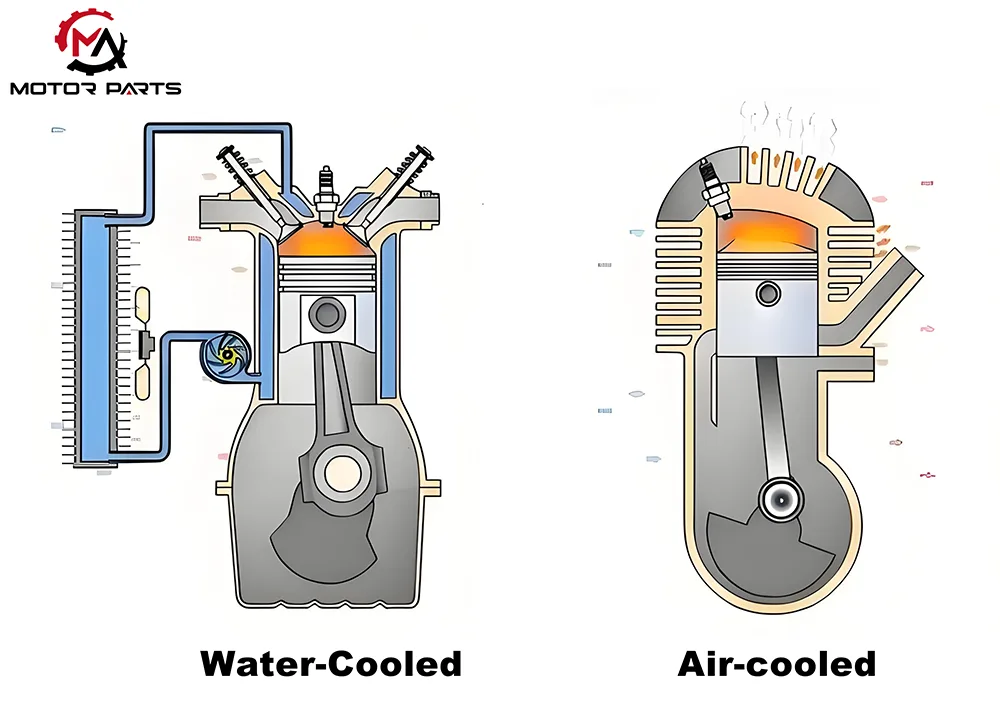
The cooling system of the engine is responsible for ensuring that the engine does not overheat during normal operation. Natural air cooling is a common way of cooling motorcycle engines. The so-called natural wind cooling refers to the process where when a motorcycle is in motion, the incoming air passes through the heat dissipation fins on the cylinder, taking away the heat generated by the engine. In addition, higher performance motorcycle engines will use more modern and efficient methods such as forced air cooling, water cooling, or oil cooling to reduce the body temperature, ensuring stable operation of the system even when the engine is operating at high loads.
According to the stroke type, number and arrangement of cylinders, cooling method, and fuel supply method, motorcycle engine parts have also shown different performances. The table below will classify motorcycle engine parts based on four types of differences, mainly in terms of structural composition, working principle, and performance.
Classified by stroke type: 2-stroke engine vs 4-stroke engine
|
Comparison aspect
|
2-stroke engine
|
4-stroke engine
|
|
Work cycle system
|
Complete one cycle in 2 strokes (compression+work), with the crankshaft rotating 1 turn.
|
Complete one cycle in 4 strokes (intake → compression → work → exhaust), with the crankshaft rotating 2 turns
|
|
Air distribution system
|
Without valves and complex valve components, intake and exhaust are achieved through the intake and exhaust ports (holes on the cylinder body), and the opening and closing are controlled by piston motion.
|
There is a complete valve system (valves, camshafts,timing chains/belts, etc.), and the valves are opened and closed regularly according to the stroke
|
|
Lubrication system
|
There is no independent oil lubrication system, relying on the mixing of fuel and oil, or the supply of oil to the crankcase by a dedicated oil pump.
|
There is an independent lubrication system (oil pump, oil passage,filter, etc.) that lubricates and participates in the combustion process. The oil circulates and lubricates before flowing back to the bottom of the oil pan and does not participate in combustion
|
|
Fuel supply system
|
Usually supplies fuel to the carburetor, and the mixture of oil and gas directly enters the crankcase
|
Carburetor or electronic fuel injection, where oil and gas are mixed in the intake manifold or cylinder to precisely control the fuel quantity
|
|
Exhaust system
|
Expansion chamber exhaust pipe is required to assist gas discharge by utilizing the pressure generated inside and outside
|
Conventional exhaust pipe+muffler, paying more attention to reducing noise and exhaust emissions
|
|
Performance characteristics
|
Simple structure, light weight, higher power under the same displacement, stronger power, but the disadvantage is high fuel consumption and large emissions waste (incomplete combustion of engine oil is discharged)
|
High durability, low fuel consumption, cleaner emissions (thorough combustion), smooth operation, but the disadvantage is the complex structure
|
|
Typical applications
|
Small motorcycles (such as off-road motorcycles and city scooters) are gradually falling behind the pace of the times
|
Most motorcycles, such as streetcars, cruisers, and race cars, are more popular among young people
|
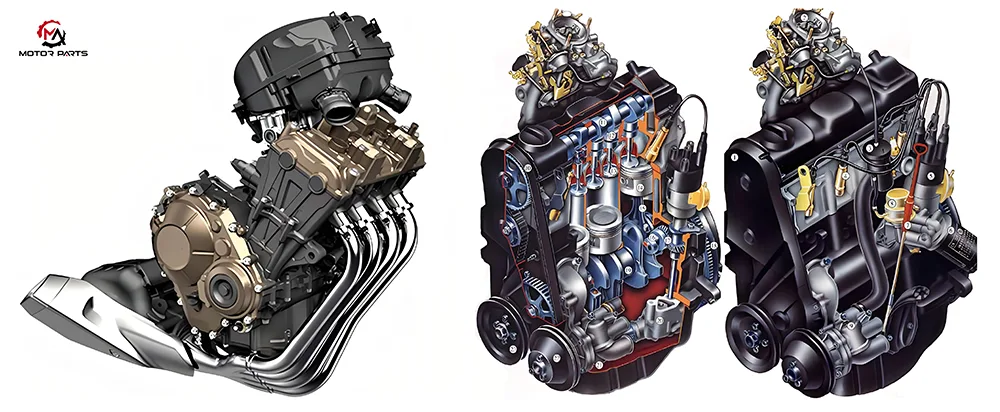
Classification by number of cylinders and arrangement: single cylinder vs multi cylinder (dual cylinder, four cylinder, etc.)
The number and arrangement of cylinders affect the smoothness of the engine's power output, the complexity of its structure, and the overall layout of the system. The main differences are reflected in the intake and exhaust, balance system, and other aspects:
|
Number of cylinders/arrangement
|
Differences in system composition
|
Typical features
|
|
Single cylinder engine
|
Valve system: single set of valves, camshaft (or no camshaft, such as two-stroke)
Intake and exhaust system: single intake manifold+single exhaust manifold
Balance system: No balance axis or single balance axis, resulting in significant vibration amplitude
|
The simplest structure, low maintenance cost, suitable for off-road and street vehicles; But when driving at high speeds, the shock absorption system performs poorly
|
|
Double cylinder engine
|
Valve system: Two sets of valves/camshafts (parallel dual cylinder) or shared components (V-cylinder)
Intake and exhaust system: dual intake manifold+dual exhaust manifold or a combination of both
Balance system: Relieve reciprocating vibration of dual cylinders through a balance shaft
Ignition system: dual spark plugs+independent ignition coils
|
The power fluency is better than that of a single cylinder, and the structure is moderately complex; By arrangement, there are parallel twincylinders (such as Honda CB500 series), V-cylinders (such as Harley Davidson), and horizontally opposed twin cylinders (such as BMW R series)
|
|
Four cylinder engine
|
Valve system: four sets of valves, multiple camshafts
Intake and exhaust system: four intake manifolds+four in one exhaust (or dual exhaust)
Balance system: Natural balance is good, but precise adjustment of crankshaft position is required
Fuel supply system: The electronic fuel injection system is more complex (mainly reflected in the four cylinder blocks having independent fuel injectors)
|
Stable power output and strong power during high-speed driving, suitable for racing (such as Yamaha R1) and cruising cars; The most complex structure, and the disadvantage of stable body is the large weight
|
Classified by cooling method: air-cooled vs water-cooled
The core of distinguishing differences in cooling systems directly affects the engine's heat dissipation capacity and applicable scenarios:
|
Cooling method
|
Differences in system composition
|
Typical features
|
|
Air - cooled engine
|
No water tank, water pump or other components, relying on heat dissipation fins outside the cylinder block/head (to increase the heat dissipation area)
Some models are equipped with deflectors to guide gas flow
No thermostat, heat dissipation relies entirely on natural/forced wind power
|
Simple structure, light weight, and easy maintenance; But the heat dissipation efficiency is low, and it is prone to overheating and scalding when driving at high speeds, making it suitable for small displacement, low load vehicle models (such as retro streetcars and small scooters)
|
|
Water-cooled engine
|
Composed of main components such as water tank, water pump, thermostat, water-cooled radiator, coolant pipe, etc
Some car models are equipped with oil coolers, which take the heat dissipation function to the next level
The thermostat controls the circulation of coolant, allowing for more precise temperature control in the normal operating environment of the engine
|
Improving heat dissipation capability, very suitable for large displacement and high-power locomotives (such as race cars and cruise cars), even if the engine has been working for a long time, it can effectively dissipate heat; But the disadvantage is that the structure is complex and the weight is relatively large
|
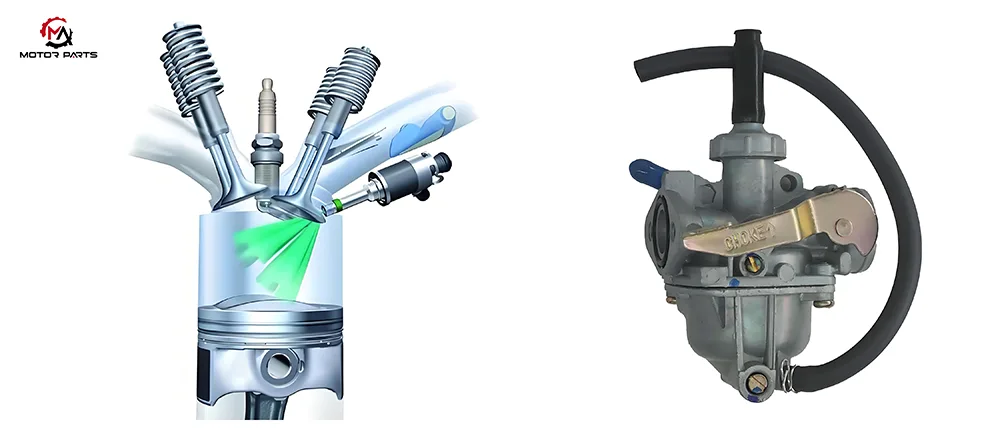
Divided by fuel supply method: carburetor vs electronic fuel injection (EFI)
The differences in fuel supply systems determine fuel utilization efficiency, emission control, and power response speed:
|
Supply mode
|
Differences in system composition
|
Typical features
|
|
Carburetor system
|
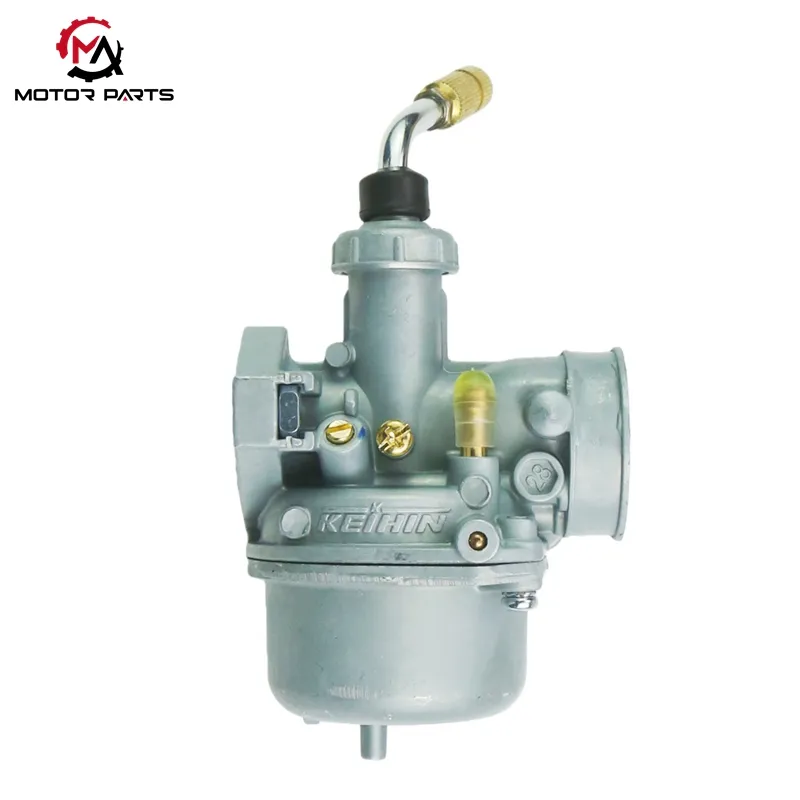
Core components: carburetor (mechanical structure, oil suction and atomization based on pressure), fuel filter
No electronic control unit, relying on mechanical adjustment (such as idle screw, oil needle)
|
Simple structure, low cost, and easy maintenance; The disadvantage is that the fuel atomization is not precise enough, resulting in incomplete fuel combustion and being greatly affected by temperature/pressure
|
|
Electronic fuel injection system (EFI)
|
Core components: ECU (Electronic Control Unit), fuel injectors, throttle valve,sensors, fuel pump
ECU can accurately calculate fuel injection quantity and delivery time based on sensor data
|
Thorough fuel atomization, fast component response, adaptability to complex road conditions (such as low temperature and high pressure environments), and clean emissions (meeting international emission standards); The disadvantage is that the structure is complex and requires specialized equipment for maintenance
|
The core differences are mainly reflected in the following aspects
● Two stroke, single cylinder, air-cooled, carburetor system: focusing on "simplicity and low cost", suitable for low load scenarios in daily travel;
● Four stroke, multi cylinder, water-cooled, electronic fuel injection system: focusing on "high efficiency, smoothness, and environmental protection", meeting the needs of high power and long endurance, is the current mainstream development direction.
● Motorcycle enthusiasts need to choose a suitable ride based on usage scenarios, maintenance costs, and performance requirements
Max Trading specializes in providing motorcycle engine parts for various brands and models, which can accurately match classic and latest models. We only work with high-quality suppliers and establish long-term cooperation. From raw material procurement to production, testing, and transportation, we supervise the entire process and have detailed standards and specifications in every link to ensure that the quality of the parts is qualified.
With rich experience and high-quality service, Max Trading has established good cooperation with numerous domestic and foreign clients. Customers have reported that after cooperation, procurement costs have been reduced, quality problems have been minimized, and business efficiency has significantly improved.
Max Trading will uphold the concepts of professionalism, integrity, and efficiency, continuously optimize the supply chain, expand products, and improve services. We will keep up with industry trends, introduce new technologies and equipment, improve production and testing levels, and strive to provide customers with better and more comprehensive solutions to achieve win-win results.