Motorcycle front shock absorbers typically use hydraulic shock absorbers, also known as fork-type shock absorbers. They primarily consist of a fork tube, a sliding rod, a spring, and a shock absorber. When the motorcycle encounters a bump in the road, the front fork moves up and down, and the spring and shock absorber work together to offset the bump, thereby reducing the acting forces on the handlebars and tires.
Front shock absorbers are mainly used to increase the shock absorber's preload and damping force. Adjusting the spring preload can adapt to varying loads and riding conditions, while adjusting the suspension can change how the suspension absorbs vibration, affecting its compliance and ride quality.
Rear Shock Absorber
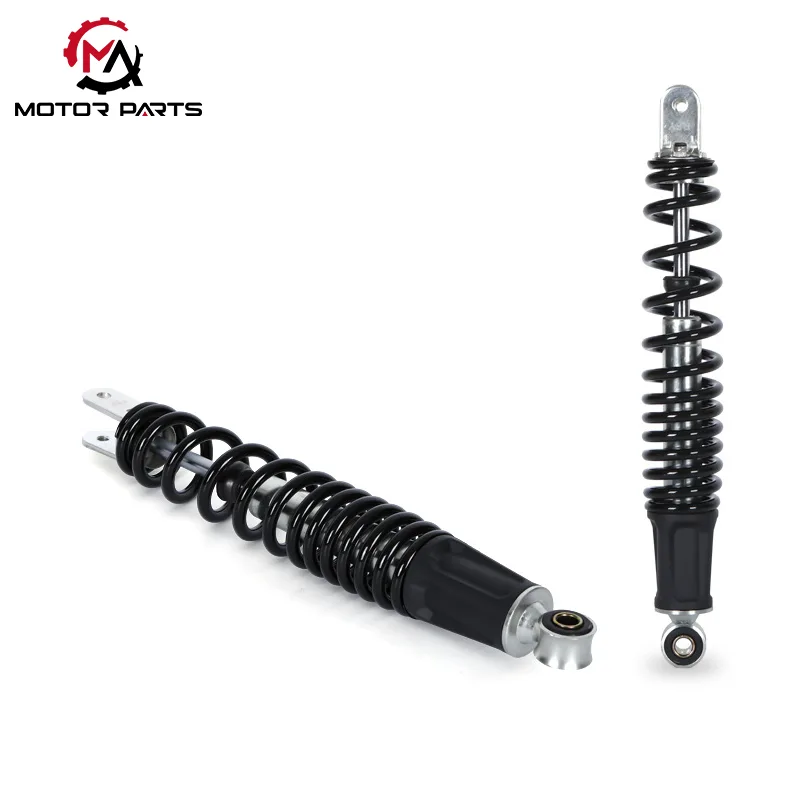
Rear shock absorbers also use hydraulic shock absorbers, but their design and construction differ from those of front shock absorbers. They are mounted to the frame and swingarm, or directly to the rear suspension. expansion.
Rear shock absorbers perform two basic functions: supporting the rear weight of the motorcycle with spring stiffness and controlling the suspension's up-and-down vibrations by providing damping. Damping is controlled friction, absorbing energy during suspension movement. Without a damper, the spring would continue to bounce after each impact.
This is the reference data of the rear shock absorber of Ningbo Max Trading Factory:
| Parameter | Value |
|---|---|
| Spring diameter | 6.7mm |
| Bore size | 10mm/M8 |
| Center distance | 350mm |
| Surface technology | Electroplating |
| Oil present | Oil present |
Whether riding on the track or the street, front shock absorbers often bear greater stress. This stress comes not only from road shock absorption, weight bearing, and weight transfer during braking, but also because the front shock absorber (front fork) also performs the important function of steering. Therefore, it must not only have sufficient shock absorption capacity but also adequate support and rebound stability.
For this reason, most racing vehicles use more stable hydraulic shock absorbers for their front shock absorbers. However, some cruisers, with their rearward center of gravity, often have greater flexibility in shock absorber design and modification.
Does the commonly stated soft or firm shock absorbers really have a significant impact on handling? While overly soft shock absorbers can be comfortable for riding, they don't provide adequate support, especially for the front shock, which can even bottom out under heavy braking. Insufficient support in corners can be disastrous, preventing the rider from pushing the limits. A soft front shock can also compress too quickly before cornering, leading to poor stability. While we're not racing drivers, we still need to find the right balance between comfort and safety.
During compression, the oil in the inner chamber flows through the pressure reducing valve into the outer chamber, while during rebound, the opposite happens. Motorcycle shock absorbers often have an internal spring.
Fully adjustable refers to preload, rebound, and compression. Preload adjustability is generally used to adjust the shock's load-bearing capacity and has nothing to do with compression and rebound speeds. It's mostly used on rear shocks and can be adjusted using an adjustment screw. Rebound and compression adjustability refers to adjusting the rebound or compression damping, thereby controlling the rebound and compression speeds.